 Image 1 of 1
Help students choose evidence that actually supports their claims.
This ready-to-use argument writing lesson for grades 6–8 teaches students how to identify and evaluate strong evidence and understand why some evidence supports a claim more effectively than others.
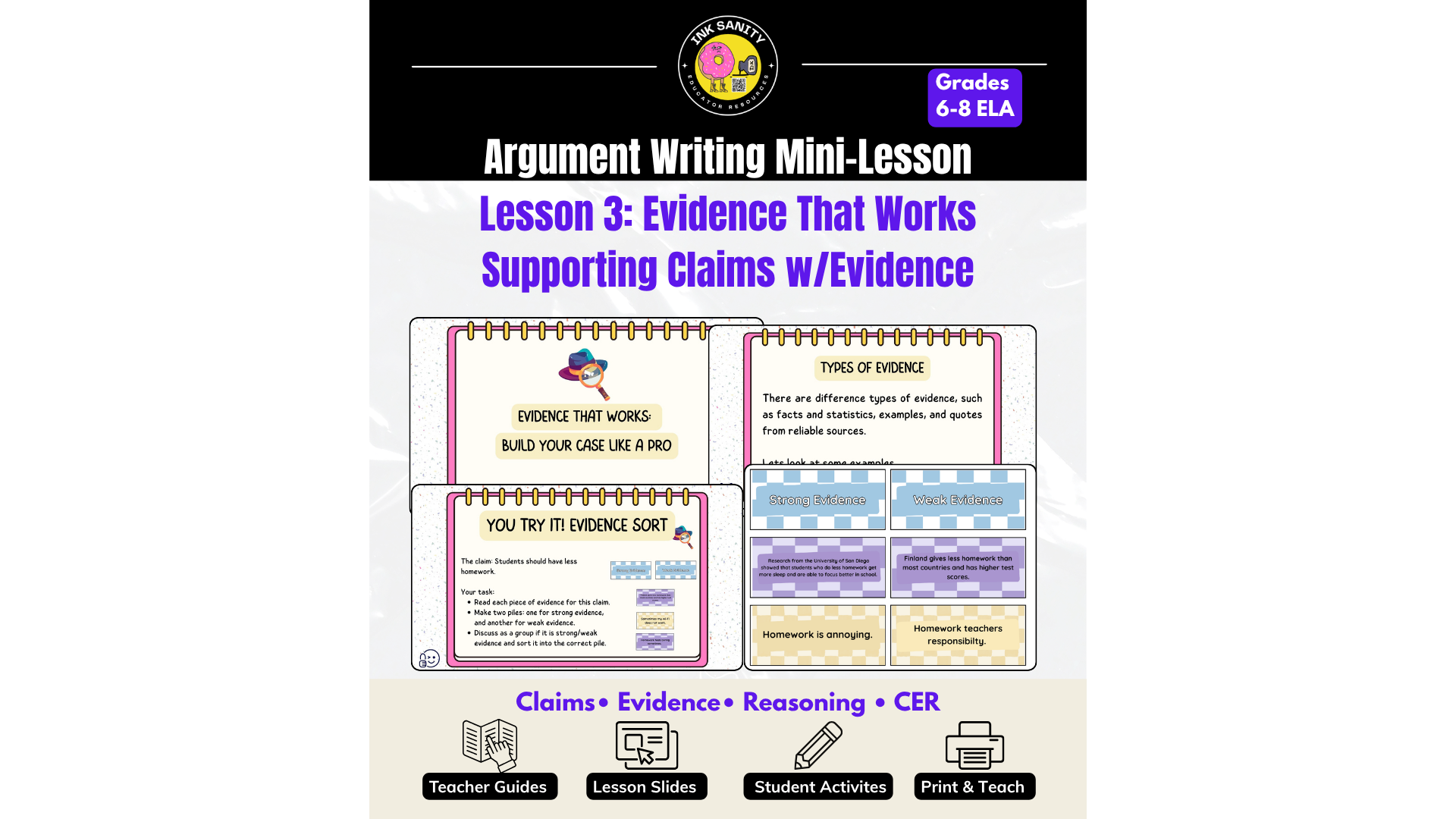
Through guided examples, discussion, and a hands-on evidence sorting activity, students practice distinguishing strong evidence, weak evidence, and off-topic information—an essential step toward writing well-supported arguments.
Teacher Guide with step-by-step lesson directions
Slide deck lesson
Evidence sorting activity
Guided practice and discussion prompts
Exit reflection
Differentiation strategies
Suggested pacing for a 45–60 minute class
Ready-to-print materials
Identifying strong and relevant evidence
Distinguishing strong evidence from weak or off-topic information
Evaluating evidence in relation to a claim
Explaining why evidence supports an argument
Building stronger, better-supported arguments
✔ Low prep — Download, project, and teach
✔ Hands-on — Students actively sort and evaluate evidence
✔ Clear and structured — Easy to follow and implement
✔ Discussion-rich — Encourages students to explain and defend their thinking
✔ Flexible — Works in whole group, small group, or writing workshop
✔ Designed for middle school — Supports developing argument writers
Argument or persuasive writing units
Writing workshop
Small-group instruction
Reteaching or intervention
Test prep and review
Introducing evidence before a CER writing task
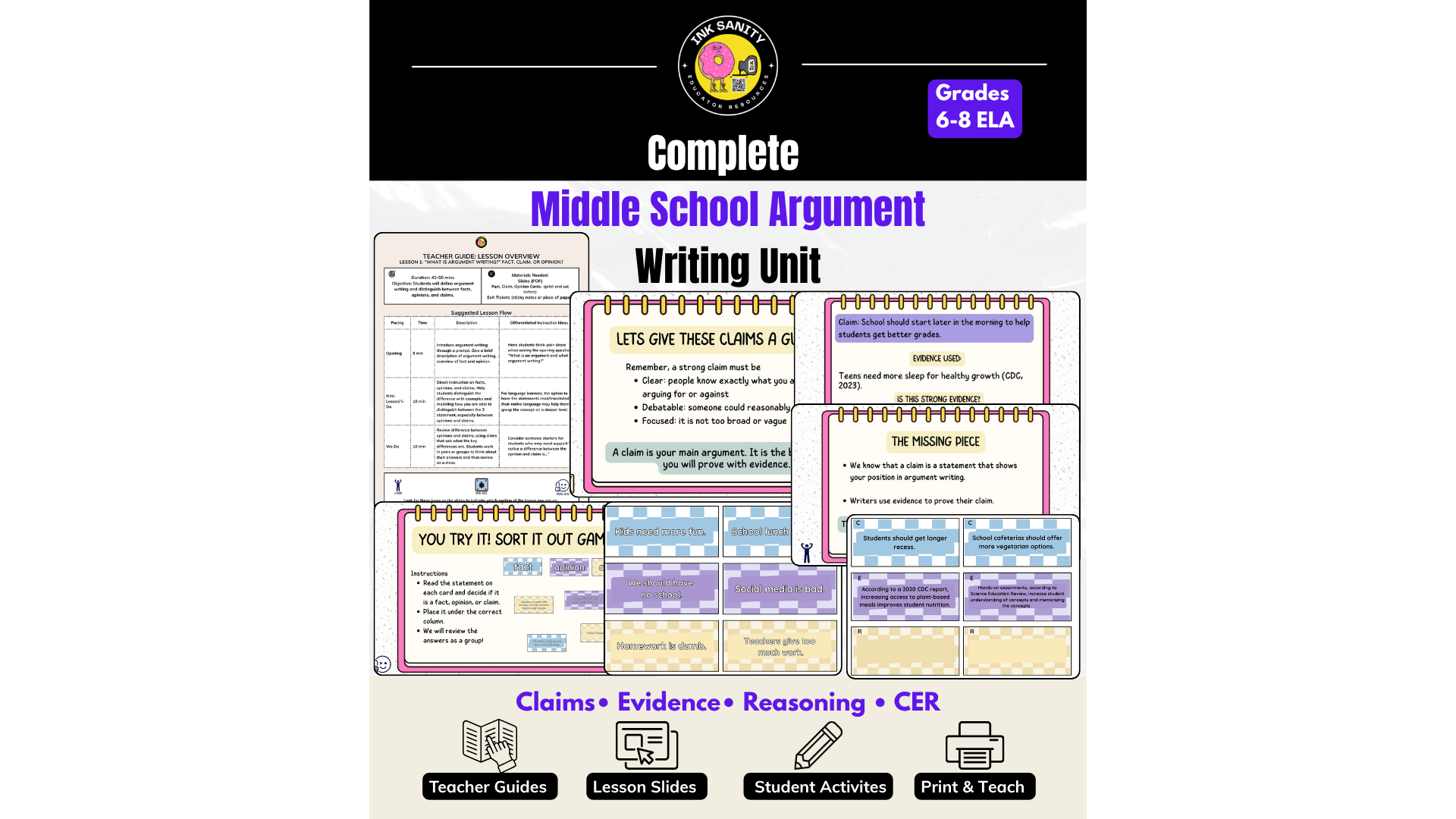
This is Lesson 3 of the complete Middle School CER Argument Writing Unit. Use it independently or combine it with the full unit to help students build the skills they need to write complete, well-supported CER arguments.
One focused lesson to help students move beyond “I found evidence” to “I chose evidence that actually proves my point.”
Help students choose evidence that actually supports their claims.
This ready-to-use argument writing lesson for grades 6–8 teaches students how to identify and evaluate strong evidence and understand why some evidence supports a claim more effectively than others.
Through guided examples, discussion, and a hands-on evidence sorting activity, students practice distinguishing strong evidence, weak evidence, and off-topic information—an essential step toward writing well-supported arguments.
Teacher Guide with step-by-step lesson directions
Slide deck lesson
Evidence sorting activity
Guided practice and discussion prompts
Exit reflection
Differentiation strategies
Suggested pacing for a 45–60 minute class
Ready-to-print materials
Identifying strong and relevant evidence
Distinguishing strong evidence from weak or off-topic information
Evaluating evidence in relation to a claim
Explaining why evidence supports an argument
Building stronger, better-supported arguments
✔ Low prep — Download, project, and teach
✔ Hands-on — Students actively sort and evaluate evidence
✔ Clear and structured — Easy to follow and implement
✔ Discussion-rich — Encourages students to explain and defend their thinking
✔ Flexible — Works in whole group, small group, or writing workshop
✔ Designed for middle school — Supports developing argument writers
Argument or persuasive writing units
Writing workshop
Small-group instruction
Reteaching or intervention
Test prep and review
Introducing evidence before a CER writing task
This is Lesson 3 of the complete Middle School CER Argument Writing Unit. Use it independently or combine it with the full unit to help students build the skills they need to write complete, well-supported CER arguments.
One focused lesson to help students move beyond “I found evidence” to “I chose evidence that actually proves my point.”